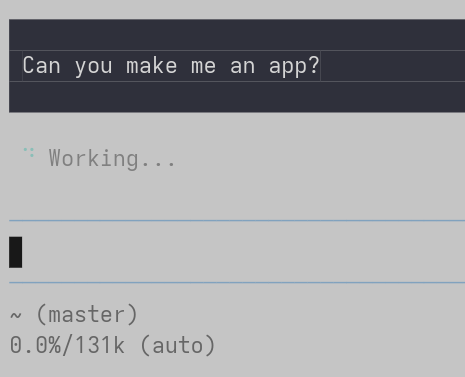
An app used to mean something. Whatever “app” meant—Mobile first? Interactive website? Anything that runs on a computer?—it was the coin of the digital realm. Apps were useful for doing things, even necessary, and not everyone could make one. A working app signified significant investment, effort, and expertise. If someone bothered to go through the effort to build an app related to one’s interests, it was worth at least taking a look.
At least once a week now, I hear from someone who made an app. Usually it’s an individual person—no need to bother enticing even a single cofounder—and usually it has the familiar tells of Claude house style. I have been playing with agentic coding, too, so I can guess at roughly the amount of labor and token cost that went into it. The answer is not that much. It is pretty, and has a lot of content on it, but it’s inexplicably blah. Albeit usually well-meaning, it’s somewhere on the spectrum of slop. Nobody asked for it, and it probably won’t work, but it asks us to take it seriously with our attention anyway.
Apps have become too cheap to be a coin of the realm. Corporate-grade stuff is different; we’re still awaiting the long-promised SaaS apocalypse, probably because the real product in SaaS is sales and compliance, not code. But for those of us not aspiring for such things, building an app is potentially so easy that it risks worthlessness. Even the few users who might have been interested before are too overwhelmed now. And probably, whatever the app is for, they could probably just do it with a chatbot instead.
What is the point of making apps anymore?
My colleague August Black has usefully coined the term “boutique permasoftware”:
Under this strategy, the emphasis is on collaborative design and development with end-users and not on any release strategy, proprietary or otherwise. I don’t sell or release the code at all. I focus on building software with constituents I know personally and avoid the promotional or documentary practices needed for commercial and/or FLOSS development. I employ this strategy to grow the software, the culture condition around it, and my personal connections to other practitioners simultaneously.
One thing I love about this paper is its critique of the norms of FLOSS—free, libre, open-source software. That stuff is built on the wisdom of crowds; you have to get a crowd, and manage it as an anonymous and rude meritocracy. Boutique permasoftware is about right-sized care. It is about building stuff with and for people you know. This is the kind of app-making that could be entering a golden age, even as LLMs erode the boutiqueness of coding. Apps might not be valuable as coins anymore, but they can still have meaning, if they are made from relationships. In this way, the concept is akin to my notion of “slow computing.”
I like to build apps for the same reasons I like to write: to clarify my thinking and communicate with others. It’s another medium for the same stuff. I can theorize all I want, but having to code those theories into an app is a useful test of their coherence. My last book, Governable Spaces, is full of little asides about the apps my collaborators and I built in the process of thinking.
I don’t think even the most vibe-coded jalopy is slop if there are real relationships at the heart of it.
Lately I have made a pair of apps while writing a new book project on protocols. I will introduce them to you, but please don’t take it as any pressure to adopt.
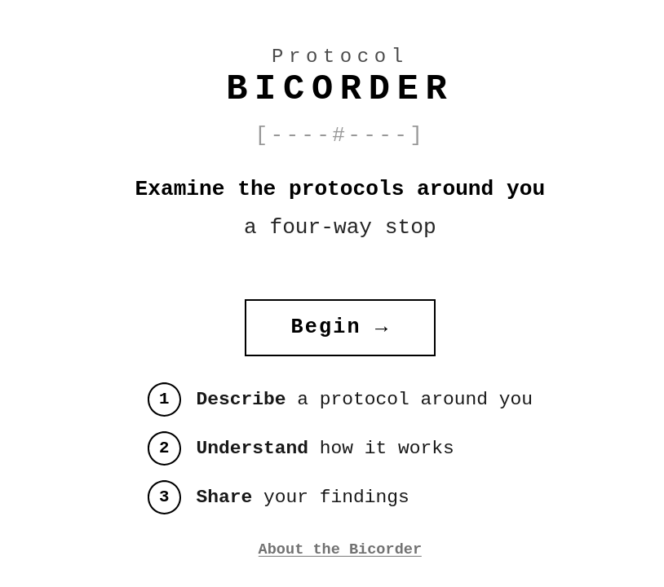
The first is the Protocol Bicorder (named after the Star Trek tricorder), which is an aid in scrutinizing and analyzing protocols. Its structure emerged for me while writing the book, and I developed it into a cohesive tool as a class project at the Protocol School, under the tutelage of my old friend Primavera De Filippi. I have used it to test and validate some of the book’s propositions and speculations, including with both human-gathered and synthetic data. I made the web app with Claude Code, but only after developing the framework first as ASCII art. It’s a Svelte static site that uploads outputs to a Git repo.
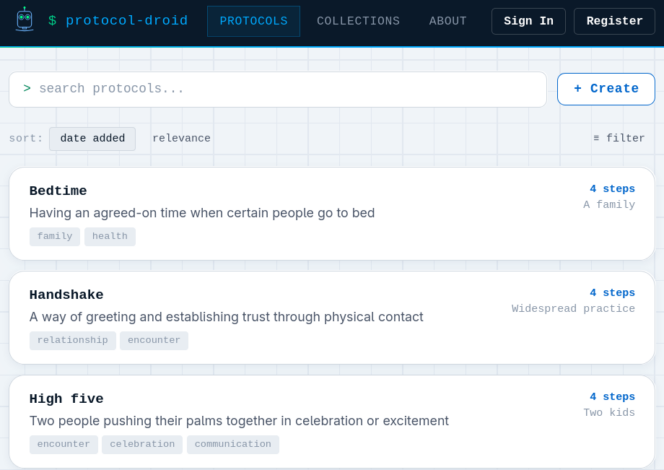
Second is Protocol Droid (named after a class of robots in Star Wars), which allows for authoring and assembling collections of protocols. I got on this after seeing my friend Kevin Owocki’s Protocol Library of printable protocol diagrams for RegenHub, a local co-working co-op here in Colorado. I made some suggestions for how the tool could be more generalizable for other communities, and he challenged me to vibe up my own. I used a Hermes Agent profile dedicated to the project, running on GLM 5.2; the result is a PHP/SQLite setup that runs on any LAMP server. There is a seed library of example protocols from around the world that users can add, but so far on the public instance I’ve just seeded it with protocols I made with my kids.
These apps’ retro icons are both on the homescreen of my phone, though I’ve only used them occasionally, to be honest. I’m continuing to work on improvements as they occur to me, or as friends suggest them. I’ve led workshops that invited people to play-test the Bicorder—and really the only hope of it making sense is if I’m there to try explaining it. I’m not sure the world would be better in any way if more people used it than those I have the chance to gather with.
Tinkerers have always made things for a user-base of just a few, so this kind of making isn’t particularly new. Even with software, hackers love to cultivate their personal libraries of scripts and dashboards. But that’s invisible to most of us. The investor class has harped so long about how the purpose of software is infinite scale at near-zero marginal cost. Monopoly or go home. Network effects. All or nothing. Perhaps only the implosion of apps as a scarce, valuable class of things can make them pointless enough to be, at last, meaningful. Like most pointless things, the meaning comes from the human relationships they grow among.